
If you would like to become an Associate Member of Therapy Dogs International, please click on the "Getting Started" link in the "Quick Links" section on the left side of the page for more information.
Please feel free to let us know if you enjoy our website. We would greatly appreciate your feedback.
Therapy Dogs Visiting
Wednesday May 1st, 2024

(R-S, NC) B ready to visit at the hospital!

(R-NE, PA) A, M, and E at the local school!

(R-MW, IA) R making his first visit!

(R-MW, WI) K is a very happy dog while she is visiting!

(R-S, OK) R and K listening to some nice stories!

(R-S, AR) M loves attention!

(R-S, NC) A is a big hit wherever he goes!

(R-MW, MI) M loves visiting with children!
Therapy Dogs Visiting
Wednesday March 6th, 2024

(R-NE, PA) R visiting a local school!

(R-MW, OH) D and M on a recent visit!

(R-MW, OH) M visiting a library!

(R-MW, SD) E sharing a smile!

(R-MW, MI) M loves visiting with people!

(R-MW, IL) A visiting a memory care facility!

(R-MW, MN) E enjoying all the attention!

(R-MW, IA) R making his 500th visit!

(R-S, GA) M on a recent visit!

(R-NE, NY) Z making her 150th visit!

(R-NE, NJ) B visiting a local high school!

(R-MW, OH) R visiting a high school!

(R-MW, IL) A working at the library!

(R-NE, NY) D loves to visit!

(R-NE, PA) O visiting the local library!

(R-S, OK) K and R love having the kids read to them!

(R-S, GA) S loves the attention she receives while visiting!

(R-MW, WI) O is a big hit wherever he goes!
Therapy Dogs Visiting
Monday August 14th, 2023
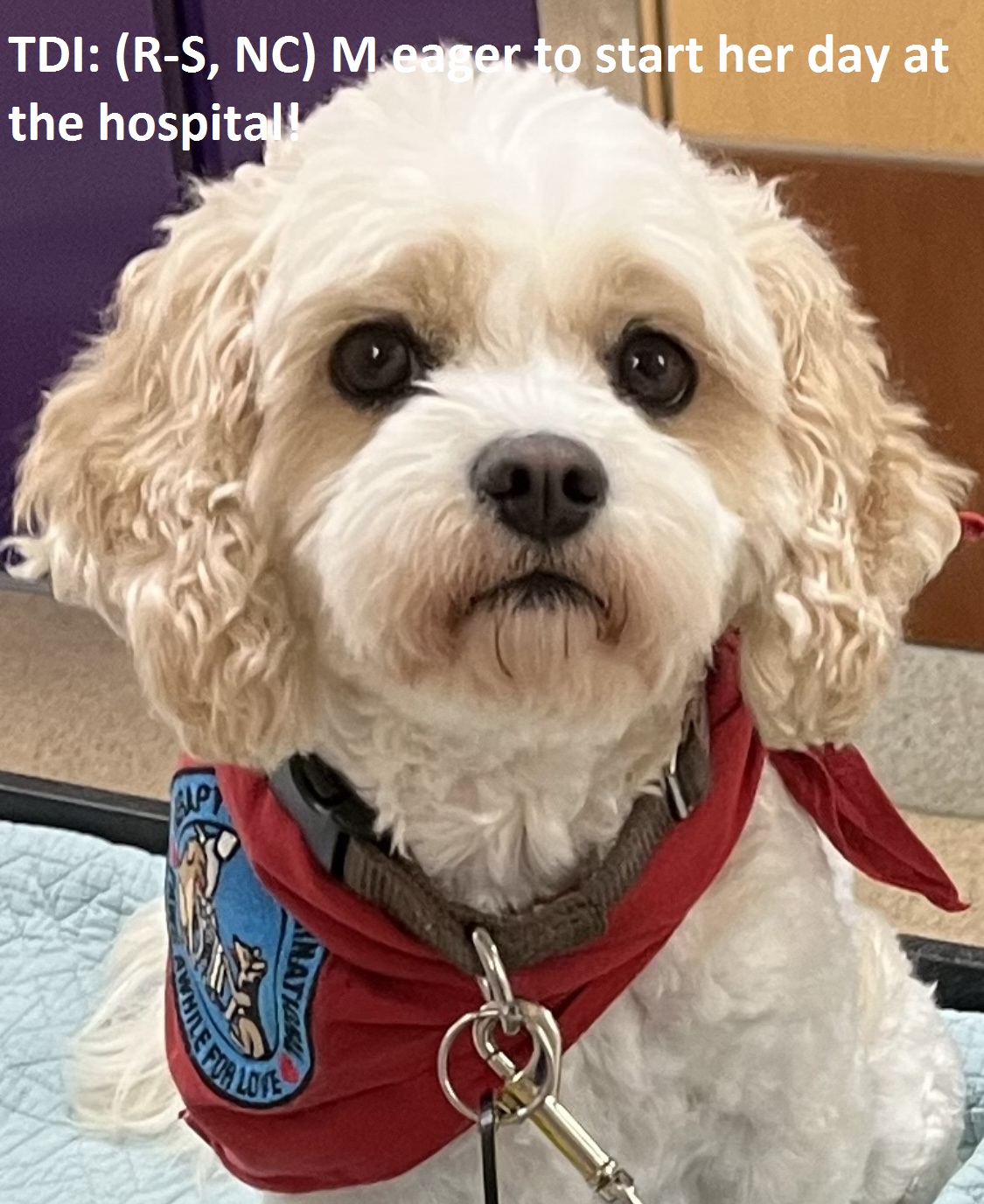
(R-S, NC) M eager to start her day at the hospital!

(R-S, SC) R visiting the local senior living facility!

(R-S, NC) MJ on a recent visit!

(R-S, FL) LD at this summer's reading challenge at the library!

(R-S, FL) B visiting the local assisted living!

(R-S, GA) J and B bringing plenty of joy and smiles to those at the assisted living!

(R-NE, NY) L visiting the kids for the "2nd grade Reading Buddies" program!

(R-NE, NY) D loves listening to the students reading to him!

(R-NE, NY) D on a visit!
Therapy Dogs At Home
Friday July 14th, 2023

(R-NE, CT) V pointing at a fish!

(R-NE, NY) H enjoying the warm weather!

(R-MW, MN) S celebrating his 9th birthday!
Therapy Dogs Visiting

(R-NW, KS) D at her Tail Waggin Tutor visit!

(R-MW, MO) B and B at the Reading to Rover program in the elementary school!

(R-NE, NY) B loves having the kids read to her every month!

(R-MW, MI) P loves making her visits!

(R-MW, IL) C visiting his local Church for their Care Night program!

(R-S, VA) A on her way to visit her local retirement home!

(R-MW, OH) S loves to visit the residence at the assisted living!

(R-W, CA) G on his very first therapy dog visit!

(R-S, NC) MJ heading home from making her visit!
"To My Rescue Dog"
Author Unknown
There's no need to flinch when I lift my hand
No need to cower each time I stand
No need to run when I come near
No need to tremble - I see your fear.
You can sleep with both eyes shut,
Don't need to jump when you wake up.
Your food is yours to eat in peace
No need to fight to keep your feast
You don't need to lie upon a hard floor
The beds and sofas are yours to explore
Don't need to sit out in the rain
The house is your shelter, your new domain.
I cannot erase the memories and fears
I can't compensate for the wasted years
All I have is what you see
But I give you it all and I give you me.
I give you these arms to comfort and hold
I give you this voice for the joys you'll be told
I give you my heart and abundance of love
I give you my soul and I hope it's enough.
Before

(R-NE, NY)

(R-W, CA)

(R-NE, NY)
After

(R-NE, NY)

(R-W, CA)

(R-NE, NY)
Before

(R-S, VA)

(R-MW, IN)

(R-S, TN)
After

(R-S, VA)

(R-MW, IN)

(R-S, TN)
Before

(R-W, AZ)

(R-MW, MI)

(R-NE, NY)
After

(R-W, AZ)

(R-MW, MI)

(R-NE, NY)
Before

(R-S, NC)

(R-NE, NY)

(R-MW, SD)
After

(R-S, NC)

(R-NE, NY)

(R-MW, SD)
Before

(R-MW, IN)

(R-NE, NH)

(R-NE, NY)
After

(R-MW, IN)

(R-NE, NH)

(R-NE, NY)
Before

(R-W, CA)

(R-NE, NY)

(R-MW, SD)
After

(R-W, CA)

(R-NE, NY)

(R-MW, SD)
Before

(R-S, AL)

(R-MW, MN)

(R-MW, NE)
After

(R-S, AL)

(R-MW, MN)

(R-MW, NE)
Before

(R-MW, MI)

(R-W, AZ)

(R-NE, NY)
After

(R-MW, MI)

(R-W, AZ)

(R-NE, NY)
Before

(R-S, MD)

(R-MW, OH)

(R-S, GA)
After

(R-S, MD)

(R-MW, OH)

(R-S, GA)
"Why I Love German Shepherd Dogs (GSDs) And How It All Began………"
By A

Once upon a time, meaning many years ago, I met a most wonderful "Being", a GERMAN SHEPHERD DOG!
We had moved to the country, willingly taking into consideration the long commute to the city to our jobs.
The road we lived on at that time was a dirt road. Mail was being delivered half a mile away to our mail box, at a wonderful neighbor's house. It was almost like I imagine America was in earlier times. At that time, we had only cats who had adopted us. Word must have gotten around that there was always food to be given if one showed up at our house. I always kept cat and dog food in my cupboard for my visitors. -That is also another story, about Gus the Basset Hound, Muncie, Impy and Stranger the cats.- Now back to the GSD STORY.
I was on the back porch working when a thunderstorm was announcing itself. It just had started to rain. Ready to go back into the house, all of a sudden out of nowhere when I saw this huge GSD standing there, looking at me. I told him: "You look like you are hungry and also need a good drying. I will not hurt you and I hope you will not hurt me!" He waited until I came out with a dish of food and ate it in front of me. After that, I dried him and invited him into the house. There was an immediate bond between us. He was my best friend from now on.
My husband, who also had loved dogs and animals like I do (one big consideration why I had married him) accepted our visitor. We made him a nice bed in our garage for the first night. Since I had to assume he belonged to someone, I called the local police the next morning to find out if someone was missing a dog, but also let them know I would like to keep him if no one claimed him. I also took him to the local vet and had him checked out. No one claimed him. He was able to stay! From the local road department I found out that he had been around for at least four weeks. They had left some of their sandwiches for him, and other people tried to take him in, but he would not go near anyone!
I believe he and I were soulmates and he was seeking me out. He was the most wonderful "Being", kind, and a friend to all animals. The cats loved him, we were family! There is a lot more to this story, but I end it for now. At a future time, I will write down the rest of the story about "Blitz", named so because he came during this thunderstorm………
The rest of the story: BLITZ OUR ANGEL
Blitz became the love of our lives. He did not need a leash (there were no close neighbors at the time). He came when he was called, he adjusted to our schedules, and was sitting in the driveway waiting for us when we were out. When I worked outside he was always with me. The cats adored him.
In his past life he must have been abused. He walked backward through doors, did not walk stairs. He was afraid to sit up in the car.
 One day while petting him, I discovered some lumps around his neck. I took him immediately to the vet. He recommended some poultices. It did not help. I took him to a different vet. There he had a complete check-up. It turned out that he had adult heart worms and Leukemia. Heart worm in the early seventies was not generally known. We certainly did not know. Not to get into details, but treating him for adult HW was not a possibility since we were told that his life expectancy was only 3 months. We were devastated! I did everything, cooked for him chicken, chicken broth, which he liked since he did not want to eat much. Having been a fan of "Adele Davis" I gave him vitamins, every thing I thought of which might possibly help. The vet had told us, he has no pain. If the time comes when you must let him go, you will know. Blitz had 6 months, then the day came when he was hanging his head down and we knew the time had come. We had hoped for a miracle, it did not happen! I understand now the miracle was that he came to us, our ANGEL. We had the privilege to take care of him and experience a love, which was so great, and stayed with me until now and will be forever!
"The 'Magic' of Dogs"
By B
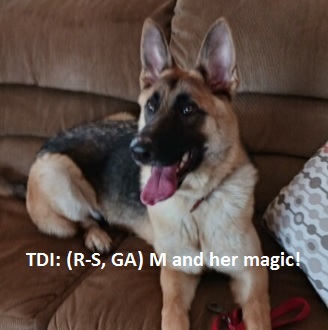
My sister Sue lives in California and is the primary caregiver of our 92 year old mother.
Sue has always had multiple animals, but for the last couple of years has not had a dog. It took her a while to get over the loss of her last dog Winston, which was a German Shepherd. A few weeks ago, she was going through ads from a Shepherd rescue when she saw a picture of a female German Shepherd, which was at San Diego animal control. She kept thinking about her for a few days, then decided it wouldn't hurt to just go look at her. She drove there not really wanting to adopt another dog, but as you have probably guessed, she walked into the kennel and the dog came to greet her and licked her hand through the wire. Next thing you know Sue is walking out with her new dog. "Mia" is a 10 month old German Shepherd which was picked up by animal control. The owners did not want her back!
As I mentioned, Sue is our mother's caregiver. Our mother cannot walk or take care of herself, and is also pretty much non-verbal. She mutters "there there" over and over again in response to any conversation. Sue was very concerned about allowing Mia around her at first, as she knew nothing about her history, since she is large and very much still a puppy. After Sue was more comfortable with Mia, and Mia learned the house rules (She didn't know anything and wasn't even housebroken.), Sue introduced her to our mother. As playful and full of energy as Mia is, she was very calm and careful with mom. She would just lay next to her, and if she was in another room and she heard mom's walker or wheelchair, she would run to be with her.
Now for the magic of dogs. It was amazing how calm this very active, young dog was around mom. The magic is Mia will lay or sit next to mom for hours at a time and mom actually talks to the dog. Mom forgets her name sometimes and will just call her "animal", but she is having conversations with Mia, not just "there there". Sometimes the words don't make any sense, but Mia doesn't care!
My sister was so excited when she called me. She told me, "You are not going to believe what is happening with mom". Of course this was wonderful news about my mother and Mia.
This is not new to me however. I have been visiting with my therapy dogs since 2003 and especially when visiting the nursing homes, I have witnessed this "magic" many times. This is why I keep visiting with my dogs. Dogs are truly magic. They bring smiles to the sad, comfort to the hurting, and even if only for a few minutes, it brings out fond memories to our seniors citizens.
The following four stories were published by SWR.de, but have been translated from German to English below. We hope you will enjoy reading them.
Cheeky dog rescued from roof!

The adventurous Shepherd Dog had to be rescued from his own cockiness in Idar-Oberstein.
Apparently the dog jumped through a mosquito screen onto the balcony and from there climbed onto the roof of the house. The only thing he didn't seem to have taken into account was that he had to somehow get down from there. Local residents called both the police and the fire department. They quickly moved in to free the German Shepherd from his predicament.

The Shepherd Dog probably jumped through a mosquito screen and got onto the roof.

The German Shepherd was no longer able to get down from the six meter high roof on its own.
A dog handler was also part of the rescue team and was finally able to lure the animal through the skylight and pull it back into the house. And the Idar-Oberstein fire department also gave the all-clear on the condition of the dog: the German Shepherd is doing well after his short trip to the roof - he was just a little exhausted, according to the head of the fire department Jörg Riemer.

A handler pulled the animal back into the house through a skylight.
Dog "Flea": How cute is this "How I Met My Master" story?

Flea got lost on the A8, caused a complete closure there, was rescued and now has a new home!
But let's go back to the beginning: The dog Flea hasn't had an easy life so far. The ten-month-old Kokoni bitch had to be rescued in Greece by a German animal protection organization. Arriving here, Flea was supposed to be placed in two families, but after a few "trial days" neither wanted to keep Flea. Flea's hopes for a "real" home were dashed for now...
FLEA'S DANGEROUS ADVENTURE!
On Monday, Flea ran away from the an animal protection organization. She ran away and spent the night outdoors. Tuesday she got lost on the freeway. The frightened fur nose ran around between fast cars and trucks. The freeway was quickly closed. Flea could be caught by passers-by.
FLEA MEETS HER NEW DAD AT THE POLICE STATION!
The police took Flea to the station, where she stayed. Then it happened: the chief of the highway police saw Flea. He decided without further ado to take her home to take care of her there. Well, and now guess who made friends there real quick? Exactly, the policeman is now Flea's new dad. The bitch finally has a "real" home - happy ending.
Light signal behind the wheel operated by a dog

On Saturday evening, a resident in Herschberg (Southwest Palatinate district) was amazed when he saw a dog in a car that turned on all the vehicle's lights.
As the police in Pirmasens announced, the resident discovered the dog - a Pug - in a parked car. The animal jumped around there and turned on all the vehicle's lights. The police then identified the owner of the dog.
Pirmasens police advised against driving licenses
She stated that the dog had already learned to operate the lights on its own. The woman was strongly advised not to teach the animal to drive!!
Excellent! - Dog finds mines in Ukraine

At a major film festival, the sniffer dog "Patron" received the special prize. He is said to have already found 200 explosive devices.
"Patron" is on duty in Ukraine to find duds and mines. They often lie around on fields where there was previously fighting. According to Ukrainian information, "Patron" has already discovered more than 200 explosive devices - and thus prevented them from injuring or killing people.
"PATRON" ALSO AWARDED IN UKRAINE
The sleuth wasn't at the film festival in Cannes, France. A representative from Ukraine accepted his award, saying, "Patron cannot be here because he is so much needed at home." Previously, "Patron" received a medal from President of Ukraine Volodymyr Zelenskyy.
The Cannes Film Festival is one of the most famous in the world. In addition to actors and films, there are also awards for dogs that have acted in films every year.
"The Kiss"
By D
Regent qualified for the 2022 Rally National Championship. I was so excited and proud of him, and of course I wanted to go. We practiced and practiced beforehand, and I felt good about how we would do.
There were 80 dogs entered in Novice, including us.
For those who are not familiar with Rally, it is an obedience competition where the dog and the handler work through a pattern of 10-15 signs. They are a team, as they work through the signs that have different obedience skills to complete.
In the RNC, we do a run in the morning and again in the afternoon. A perfect score is 100 for each run. The runs are then averaged together for a final score.
In the morning, when it was Regent's and my turn, he was somewhat distracted by all that was going on outside the ring, but we made it through to the last sign which called for a down. As I asked for a down, I bent forward and asked again when he did not respond to the first command.
 Regent looked up at me and gave me a big kiss right on my face. We received an NQ for that run, but I could not be mad at him. He was telling me he loved me.
The afternoon run he did much better with a score of 97. The moral of this story is that people are always watching how you act.
I received messages from strangers that everyone watching thought he was so sweet when he kissed me and that he was the "goodest dog " that everyone wanted to take home. What really hit home, was when a total stranger told me more than Regent's kiss, that my actions of love and patience when we came out of the ring were what she noticed and that there were many that did not act that way when they had a bad go.
So win or lose, show your dog you love them no matter what. After all, they love us unconditionally.
We wanted to make you aware of the existence of this tick species. While it is not yet endemic to North America, it is very possible that it finds its way here eventually. The story was published by SWR.de, but has been translated from German to English below. You can also search online for additional information pertaining to the Hyalomma tick.
Tropical tick spotted - Hyalomma likes dry heat

They appeared in the Vorderpfalz and mainly torment horses. When the fast-moving ticks burrow into people's skin, they can transmit the viral disease CCHF.
Hot and dry summer weather favors a species of tick that has so far mainly been native to Africa. According to the Stuttgart tick researcher Ute Mackenstedt, and to current information from the Vorderpfalz, the tick, according to its genus name, which is called Hyalomma, is observed more frequently this year than in the previous, rather wet year.
Striped legs and very fast
"We have never come across this animal before," reports the rider Susanne Mengelberg in Bobenheim-Roxheim (Rhine-Palatinate district). The special size and the striped legs are striking. Within a few days, the tick species appeared five times, leaving bite wounds and sucking points on particularly sensitive areas of the horse's skin. "She runs, she is fast." Unlike the common woodbuck (Ixodes ricinus), which senses its victims via chemical signals such as temperature and smell and then attaches itself to them in the grass or undergrowth, Hyalomma ticks are active hunters that can pursue their victims over long distances.
Ticks also go to humans
The Greek name refers to the ability to see: Hyalomma means something like "glass eye". So far, two different species have appeared in Germany, Hyalomma rufipes, which is native to Africa, and Hyalomma marginatum, which is widespread in south-eastern Europe and Turkey. In addition to horses and other large mammals, the ticks also go to humans.
Climate change could encourage Hyalomma species
"We assume that Hyalomma came to our latitudes with migratory birds," says the expert Mackenstedt, who researches in the parasitology department at the University of Stuttgart-Hohenheim. In the developmental stage of the nymph, the ticks attach themselves to the birds, then fall off and, in favorable weather conditions, develop into adults.
In the vicinity of the riding meadows near Bobenheim-Roxheim there are several ponds with many Canada geese and greylag geese. "The occurrence of hyalomma correlates very well with the routes of bird flight," says Mackenstedt. This includes the Rhine Valley. There is also evidence for Baden-Württemberg, Hesse, North Rhine-Westphalia and Lower Saxony.
"In the coming decades, climate change could result in a Hyalomma species being able to establish itself here and become at home," says the scientist. Depending on the amount of blood sucked, Hyalomma rufipes lays nearly 2,000 eggs at each oviposition. "The high number of offspring is a factor that can make it easier for the tick to conquer a new habitat," explains the Robert Koch Institute.
Thousands of people have contracted it in Turkey since 2002
Hyalomma ticks can transmit Crimean-Congo fever (CCHF), a viral infection with a high mortality rate. Thousands of people have contracted CCHF in Turkey since 2002; According to the RKI, the disease had a fatal course in almost five percent of the cases. The state investigation office of Rhineland-Palatinate warned of the Hyalomma ticks in 2018 - even then the summer was particularly dry and hot. However, the occurrence of hyalomma doesn't have to be reported. The authorities therefore have no information about the current distribution. Rider Susanne Mengelberg is concerned: "I very much hope to never meet a Hyalomma again."
"Three Strikes!"
By C
Recently, three of my four dogs were bitten by a snake in our own backyard. We don't know what kind of snake it was but we assume it was a copperhead since that is the most common poisonous snake in our area.
I was outside with them when it happened but I was on the other side of the yard doing a little yard-work. I heard a yelp and saw my Boxer, Waylon, running towards the house. He was quickly followed by April, the Australian Kelpie, Danny the mixed terrier and retired Therapy Dog and last but not least, Glenda the miniature Poodle who is an active Therapy Dog.
 When I got into the house, they were all acting oddly. It was then that I noticed Waylon's face was swelling. I saw what looked like two puncture wounds on his right cheek. When I touched his lip, he screamed. I realized he must have been bitten by a snake so my husband put him in the car and headed for the animal emergency clinic. The other dogs were still very quiet and a few minutes later I saw that April's face was also very swollen, with puncture wounds on her left cheek. So I put her in my car and got to the ER about twenty minutes after my husband.
 Both dogs had blood drawn and luckily neither needed antivenin, but April needed medication to calm down just to be examined. She was trying to hide under the chairs and shaking like a leaf. Waylon on the other hand, was very calm other than having the typical Boxer wiggle butt. All of the staff at the clinic kept complimenting him on his sweet behavior and telling us how lucky we were to have a dog with such a good temperament, who even in pain was gentle and cooperative.
We were sent home with pain medication and instructions to use ice packs on their faces several times a day to control the swelling which they said would get worse before it got better. We were also told to watch for signs of infection or necrosis at the puncture wounds. The most interesting thing we learned was that most dogs do not succumb to copperhead bites and that had been my biggest fear. It's really just a matter of controlling the pain and swelling.
 Once we got Waylon and April home we were settling everyone down and I noticed that Danny the terrier was looking puny. My husband started examining him and found swelling under his chin, although it was not as extreme as the other dogs. His furry, scruffy beard had hidden the swelling earlier. We did not take him to the ER, knowing that they would just give us the same advice so we treated him at home.
The land behind our home is being cleared and we wondered if the snake wandered over to our yard looking for a safer home. After searching, we were unable to find the snake but we did spray a product called "Snake-Away" around the perimeter of the backyard, hoping to keep other snakes from deciding they like the look of our yard.
I would like to tell Mr. Snake, "Three strikes and you're out!"
"Life With Magic"
By A
 A good start on Magic's story would be to tell how she got her name. Back Rivers Magic Freeway "Magic" was whelped mid morning of May 6th, 2009. Twenty four hours after all the other puppies, we had taken Abby and a basket of three puppies, to town for a vet check. After the exam, we were told Abby has no more puppies to whelp. We had been hoping for a second female that we could keep and train for Brace in the AKC Obedience Ring. Disappointed, I patted Abby on the head and told her we would buy a little female for her companion. She swung her head around and looked at me as if to say, "don't worry Mom I'll get you another puppy." Just a short time later on the trip home, as we flew down Hwy I-95 South going seventy plus mph, there was movement on the seat on the other side of Abby. I leaned over and there next to Abby was a living wet puppy. We stopped at the park, Abby cleaned up the new addition, a female, I added it to the basket, then there were FOUR. What else can you name the surprise result of a magic trick, but Magic!
Along with Magic, we ended up keeping the runt of the litter because he was an unsaleable puppy, Rocky. Life was good and Abby was "Mother of the Year", like I knew she would be. Magic grew big and strong and super smart. On the other hand, Rocky was plauged with problems from day one. Abby made the call on that puppy and raised the little guy. He didn't walk until he was eight weeks old, cryptorchid, two hernias, teeth extractions, and puppy cataracts to name a few problems. We've always joked that Rocky doesn't bark, he just goes "cha-ching", "cha-ching" like a cash register. To this day Rocky and Magic are the closest of companions.
At fifteen months old, Magic was well established in the obedience ring like Abby. She had her first title before she was a year old, but a much higher score than Abby. On August 24th, 2010, a terrible ordeal started. I was out on our property with only Magic. While working, I turned my back for a few minutes and she was gone. Earlier I had seen a herd of deer come through. They cross our property all the time. No Magic and no deer, she had taken off after them. Our twenty-two acres backed up to a twelve thousand acre hunt club. There was no fence in-between and on occasion our three dogs would cross into the club chasing deer and we would call them back. Magic was a young dog going in alone. No bossy Abby or slow Rocky to keep her in tow this time.
We searched all that evening by calling her as we hiked into the property. The club land was a maze of ATV trails, fire brakes, and Georgia Power right-of-ways. We advertised and I left fliers at businesses in the area, all humane societies, veterinary offices, and dog pounds. We visited every house whose property bordered the hunting land. There was a caretaker's house that could be seen up the power lines just inside of the club. They had not seen her or any sign of her. No one else lived on all those acres. Hunting season had not started. After more than a week, I still went out to the edge of our property and called her every morning and evening when the air was clear and voices carry. We quit hiking because of snakes on the move at that time of year. I never stopped going to the property line and calling her. When September started, the hunters began prepping their stands and blinds. The president of the club sent word out to his members to watch for a blue/grey female Standard Poodle. I just kept hoping she would magically appear.
Magic had been gone twelve days, not a sign or sighting. On that afternoon of the twelfth day, I parked my car in the garage and stepped out onto the breezeway to the house. There, on the lawn below the porch I came face to face with Abby. All I could think of is how did she get out of the house? I realized in that instant, I was looking at Magic. Mother and daughter look identical. To this day, I feel that one of the hunters found her. They most likely brought her to the edge of our property and released her. I had made every effort to keep a good relationship with my neighbors, the hunt club. They were allowed to come onto my property to get their dogs. She loves men, all men and an offer of an ATV ride would be an open invitation. I realized then that I had given up finding her and this was a total surprise. Great "Magic trick", girl! She had lost fifteen pounds. She wouldn't let us touch her legs or feet. She would move away or cry in pain. She smelled of ammonia. I believe her body had entered a stage of starvation. There is no food and very little water on that property, only dangerous wildlife. You couldn't even bathe the ammonia smell away. It lasted for about a month. Shortly, the bowel movements of sticks and sand and her funky odor made way for the Magic that we knew and loved.
Magic and I were chalking up the obedience titles. Abby had finished her AKC Open title and was moving into Utility. Before we knew it Magic had completed five titles. She was four and a half years old. She had gone into the ring fifteen times, she never NQ'd, and had five first places. Magic and Abby were practicing for brace. She and I had started working in and preparing for the Open ring, but something was going wrong with Magic. She was having some health problems. It is now 2013 and Magic has no balance. She is not eating, yet can't stop vomiting. We had chalked up a series of vet visits. Same story every time. They would give her electrolytes to get her back on her feet. I would bring her home and do exactly what they told me to do. Within a couple of weeks, Magic is sick again. The staff at the clinic had started making fun of me. They were wanting to know what I'm doing to my dog and if I was unable to follow instructions. We've now moved to a new house and Magic was sicker than ever. She had the dry heaves and had retched all night. She couldn't walk across the floor. She had a discharge coming from her eyes and nose.
We got a referral from our vet to take her to a specialist in Jacksonville, Florida. Magic was critical! She would not be carried in or ride on a gurney. She dragged herself and staggered in across the floor. Within thirty minutes of walking into North Florida Veterinary Specialists, we had a diagnosis, Addison's Disease. We started her on medication. Every twenty-eight days a shot and every other day a pill for the rest of her life. Addison's Disease is not compatible with life and Magic and our lives would never be the same. Anything surrounding Magic is magic and she thrived. I never put her back in the obedience ring. Swings in stress and weather conditions, which a competitor can't control, dictated her career was over. My handler buddy and great friend encouraged me to start her in TDI with Abby, but it took me years to risk it. It wasn't until Abby DSR, was on the verge of retiring from TDI, that I started Magic. She loved every minute of visiting. I'm only sorry she never got to visit in brace with her Mom. Magic had a very favorite nursing home facility that was all about her and she was all about them. After Abby retired, Magic and I branched out into some of Abby's facilities. Everyone thought she was Abby.
We lost Abby in May of 2020 at the age of fourteen. Because of COVID, visiting was over for all of us. Today Magic is thirteen and very retired. Her legs just can't carry her any distance any more. For all I know, she might be the oldest living Addison dog. The legs failing and intestinal disturbances surface every now and then. She and Rocky are still fast friends and recline on the banks of the small lake we live on, watching turtles. Even with Rocky's blindness, he lays down beside her on the bank, like he is not missing a thing. I'm sure that she tells him how many turtles are surfacing and "look there Rocky, another one!" We make a vet visit every twenty-eight days for her shot and Dr. Pope just shakes his head in disbelief. That has been our life with Magic. We are the luckiest dog owners in the world!

Rocky and Magic watching for turtles on the banks of the lake.
"Life with German Shepherds"
By B
I have owned many German Shepherds and it is my breed of choice. They are loyal, intelligent, and very trainable. Many people however are very afraid of them. I have had three therapy dogs that were the sweetest dogs and changed a great many people's opinions of GSDs.
This is a story of life with GSDs. Quite a few years ago, my husband used to receive regular UPS packages. Our UPS driver John, loved my dogs. At the time, I had three adult GSDs and John would deliver two or three times a week. John always had dog biscuits in his truck. My rule with John was that my dogs do not get free treats, they have to do something for the reward. John would have them sit in order to get their treat. Sometimes, he would let them get up in his truck, sit, then get their treat. We live out in the country and off a dirt road, so you could hear the UPS truck rattling down the road a mile away. Even if the dogs were in the house, they could hear the truck coming. I would let them out and they would patiently wait next to the house for John to get up the driveway with their treats.
On one such day, they heard the truck coming, so I let them out to wait for John. I went to put on my shoes, so I could go out and get the package, and thank John. I walked out of the house and all three dogs were sitting in the truck, just as pretty as can be. That perfect alert intense pose! I wondered what was taking John so long to get the package, and as I got closer to the truck I could hear a very low trembling voice "Help, help, anyone there, please help." I called the dogs out of the truck and a young man appeared. Apparently John was on vacation and this was a new driver. I explained to him how John feeds them treats and that's what they wanted. I also told him John loves dogs and many people in this area have dogs, so if he feeds mine, he probably feeds other people's dogs too. I think the poor guy thought he was going to be eaten that day. His next comment was "I think I will stop and buy some dog biscuits." He made other deliveries to our house and loved my dogs, despite the unfortunate first meeting.
"Why I Visit With My Dogs"
By B
WHY I VISIT WITH MY DOGS
I am asked frequently "Why do you have therapy dogs and why do you visit with them so often?"
To answer this question, I would like to provide a little information about myself and although I could tell you many stories, there are three I would like to share.
I have had therapy dogs since 2003 and that is when my story of visiting with my first therapy dog Lucy begins. I had never visited before, so a very kind TDI member invited me to visit with him and his tiny five pound dog Teenie, until I was comfortable visiting by myself. As I stated, Teenie was a five pound dog and Lucy was a one hundred ten pound German Shepherd. They were quite a head turning pair. We were visiting the local hospital and had entered a room with a non-responsive patient, who had been in a horrible accident. The patient's brother was in the room and told us he had not moved or responded since he came in. He also told us how much his brother loved dogs and that it was a shame he was missing out on this visit. Teenie's owner asked the brother if it would be okay to put Teenie next to the patient on the bed. Absolutely was the answer, so Teenie was placed gently next to the patient's arm and Lucy went to the other side and was nuzzling his other hand. After a couple of minutes, the patient opened his eyes and started talking to the dogs. Nobody could hold back the tears.
THIS IS WHY I VISIT
My second story happened a few years ago with my therapy dog Barkley. Every week we would visit a senior care facility, which had a memory wing for Alzheimer's patients. We were always diligent about visiting these patients. One resident was declining rapidly and although her family was visiting from out of town, she was almost oblivious of their presence. We had not visited with her before, as she was new to the facility. The staff had dressed her and put her in a wheelchair to visit the family in the communal area. I walked in and she just about jumped out of her wheelchair to make her way to Barkley, a one hundred fifteen pound German Shepherd. She started talking to him and loving on him. The family was able to spend a couple of happy days with her. She passed away peacefully in her sleep three days later. Afterwards, the family told us she had a dog that looked like Barkley and she thought that it was him.
THIS IS WHY I VISIT
My last story happened just two weeks ago with my newest therapy dog BJ, who I adopted one year ago from animal control. We visit a clinic for rehabilitation from drugs and psychology problems on a weekly basis. We are included in their group therapy sessions. One patient, a veteran who suffered from anxiety attacks in crowded situations, never attended a group therapy session because of this issue. When he learned my dogs were visiting, he wanted to see them, so he went into the room. As we entered, he was pacing in a circle, with his head lowered and breathing heavily. BJ immediately went to him, and the gentleman started petting and talking to him. After just a few minutes, he looked up and said " I could feel a panic attack coming on and this dog must have known. He came right to me and I feel myself calming down petting him." I have seen many times that my dogs gravitate to a certain person who needs them the most.
THIS IS WHY I VISIT
"What are the Odds....?"
By D

Although this a not a story about a therapy dog, it is a story worth sharing. Most people who like dogs also like horses and this is a story about a horse.
I have loved horses all my life. My love for dogs is easy to understand, my whole family are dog lovers. But I'm sure my parents asked each other many times where did this horse crazy girl come from. Not that they disliked horses, they just had never owned one.
When I was 12 years old, I joined a 4H Club for horses and the advisor let me use one of his horses. My parents saw that I was not going to lose interest, so when I was 13 years old they agreed I could have a horse of my own.
They asked my 4H advisor to find me a horse, as they had no knowledge of what type, etc of horse I needed. I remember my 4H advisor and I went to a nearby town to bring home my horse. No one was at the residence and he loaded her into the trailer. I was overjoyed that I had a horse. I could hardly wait to get home!
Her name was Susie and she was a strawberry roan with a black mane and tail, white stockings, and a blaze face. I rode her day in and day out. I took her many years to the county fair and I loved her. After I left home, my younger sister rode her. As time passed, she was sold to another family where she lived out her life.
Update to April 2022. I was asked by a lady that lives on the same road that my horses are boarded at now, if I would teach her granddaughter to ride horses. We hit it off right away. Grandmother began telling me about her horse when she was a young girl. This horse was 2 years old when she got her and she said she got bucked off a lot, but she learned to ride her.
As I listened to her stories, I began putting two and two together. I knew the road I board my horses on now was the road, but I could not recall which house it was, as it would have been many years ago. As grandmother talked about the horse she had as a young girl I asked "what was your horses name?" and she answered Susie. I said, Oh my gosh I had your horse! She described her and I said yes! That's her! She told me her father had sold Susie and she knew what town she went to, but she never knew who had her. Now she knows her first horse was loved and taken care of when she left her, and I found my first horse's previous owner.
What were the odds of this happening after so many years? But due to another generation (her granddaughter) wanting to learn to ride horses, we found we had been owners of the same horse.
"What is a Dangerous Dog Breed?"
By C
 In my case it has recently been a YorkiePoo. Yes, I said a YorkiePoo. That cute little breed that is often allowed to get away with behaviors that would never be allowed in a big dog.
 I have owned a pet sitting and dog walking business for the last seventeen years and have taken care of many different breeds. This particular YorkiePoo was a rescue, so not much is known of his history. When one of my sitters entered the home, after having met the dog a few days before, he ran up behind her and bit her on the back of the leg. He didn't break the skin but caused bruising. The next time he ran straight to her and bit her on the ankle, breaking the skin. She refused to continue pet sitting for this dog so I had to take over.
 Knowing that he was aggressive and an ankle biter, I prepared by wearing heavy blue jeans and leather hiking boots. I also brought along a heavy clipboard to use as a shield. My pockets were filled with smelly dog treats and I hoped that this little guy was food motivated.
 As I entered the house, I realized that the dog was barking and lunging at me at chest height. The home owners had their sofa pushed against the wall, even with the exterior doorframe. So the dog was able to get to me from the back of the sofa, which is when my clipboard came in handy. I held it in front of me to protect my upper body from being bitten. He then jumped off of the sofa and came charging at me. That's when I pulled the cookies out of my pocket. I tossed them in front of me and he stopped his attack so that he could gobble up the treats. After that, he was my buddy and actually cuddled with me on the sofa. I still didn't entirely trust him and each time I entered the house he started a little game of "protect the house" and I would ignore him, other than throwing the treats on the ground to redirect him.
Even though this dog is small, having a ten pound projectile coming at you with teeth bared is unnerving. Dog bites, even from small dogs, can become infected leading to potentially dangerous results. I take care of Pit Bulls, Rottweilers, Dobermans, etc. and never have any fear of them, but this YorkiePoo.
There is a reason that TDI's testing requirements do not differentiate based on the size of the dog. A small dog is capable of being trained to do everything that a big dog can do. My second therapy dog was a thirteen pound Poodle-Jack Russell-Shih Tzu mix and probably the best behaved dog I have ever had. I practiced what I preached with her. She was taken to obedience classes as soon as she was old enough. She competed in Agility and worked as a Therapy dog for sixteen years. I always expected big dog behavior from her and I got it.
What breed is a dangerous dog breed? Any breed is capable of biting. I think socialization is the key, no matter the size of the dog. Every dog deserves the opportunity to be a good dog!
This article was written to demonstrate that all dogs, no matter what kind of breed can bite not only larger breeds from which some are listed as dangerous dogs. We just picked a small dog which should emphasize that for our purpose all breeds must be trained and tested regardless of the size. All dogs have a common ancestor, the Wolf. Mankind trained dogs for specific purposes by selecting certain needed or wanted characteristics (Breed Specifics).
"By the End of Every Summer Season, They Have a Dog Swim at Our City Pool"
By D
 Regent and I love this day! He is a water loving German Shepherd Dog and all of his doggy and human friends show up to swim and play. At the swim last year, Regent spotted his Golden Retriever friend Charlie across the pool. Regent started crying and yelping in excitement. They had not seen each other in years, but had played together as puppies. Charlie recognized Regent too and a joyful reunion was on.
Sometimes we take our dogs for granted. I never thought Regent would remember Charlie after that much time, but the two old friends remembered and were happy to see each other. We humans can learn a lot from dogs.
No Charlie this year, but Regent had several friends to play with. Sadie, Honey, and Sugar were all there and I noticed how Regent knew them instantly. He didn't cry when he saw them like he did with Charlie, but he sees them more often.
This year I saw how dog fights can happen so easily. A couple came into the pool area with three big dogs. As they came in, they were immediately all over Regent sniffing and circling him. He remained calm. I told him to sit and asked the people to please come get their dogs. A bad situation could have developed if Regent were not such a well socialized dog with a good temperament. German Shepherd Dogs sometimes get a bad reputation that is not deserved. I'm proud of my boy!

The Importance of the Socialization of Dogs from Puppy-hood on. Dogs Should Have the Opportunity to Interact with Other Dogs.
"BJ's Story"
This Is A True Story Of The Little Black Dog Nobody Wanted
By B
 BJ was surrendered to animal control by his owner because they did not want him anymore. He was overlooked by many potential adopters because the fact is black dogs are not very adoptable. He was there for months and was becoming very depressed. Finally, a family adopted him and he was so excited. Unfortunately, due to no fault of BJ, he was returned three days later. Well, poor BJ just shut down and sat in a corner very depressed. I was helping with the spay/neuter program there and felt so sorry for him that I took him home. He immediately bonded with my other dog Sophie. After about two weeks of living with us, his real personality started coming out. This dog loves people, so I decided to work towards him becoming a Therapy Dog.
Obedience training was a challenge at the beginning. BJ did not think he needed to know any of that, but I persisted and one day it was like he realized it was actually fun. So with Sophie's help (she loves training) we worked hard and he passed the TDI Test. He received his credentials two weeks before Christmas, so he and Sophie visited together with their Christmas bells. He visited like a pro. He really loves people and is going to be an awesome Therapy Dog! Sophie has been visiting for two years and is a good Therapy Dog, but BJ is awesome and only getting better. Sophie was also a rescue. Sometimes rescues make the best companions, as they are so appreciative when given a good home. Both BJ and Sophie are in their forever home and loving their jobs. When the bandanas come out, they are ready to go work!

"Ding Dong The Witch Is Dead"
By B
 Minnie was a cat that I rescued with her sister when they were very young kittens. I bottle raised these kittens and they were very sweet. As they got older, Minnie was very particular about who was allowed to pet her and when. She loved me, but not many others.
At the time that I got Minnie, I had three adult German Shepherds and she grew up with them. They were always wonderful with other animals and never bothered her or her sister, in fact many times I found her sister sleeping with or being washed by the dogs. This however was not good enough for Minnie, she wanted to control them. Her demeanor around the dogs was hilarious, when she walked across the room they would all look away from her and cower. It was as if they were saying "just don't look her in the eye". Occasionally she would stop and act like she was going to run at one just to keep them in line. She would back Barkley, my 115 lb male, into the bathroom and not let him out. The funniest Minnie story is when I rescued Cash. Cash was a half-brother to Barkley. He was two years old, untrained, and very neglected and I was told he would kill cats. I had to take him in. A couple of days after Cash came to live at my house, Minnie walked through the living room. Cash was immediately reactive and started after her; well… the other dogs all started for the back door scratching and trying to go out absolutely terrified as if saying "let us out, she's going to go ballistic…. help help!!" All this commotion made Cash stop in his tracks, only to be faced eye to eye with Minnie who sat down and started washing herself, stopping once every few seconds to stare him down. That was the last time Cash ever bothered my cats. As far as I know, she never actually touched any dogs, just threatened them. I have a friend that had me take her dog for a weekend and when he got home never bothered her cats again....
When Minnie passed away of natural causes, needless to say she was not mourned by the dogs. In fact if they could sing, it would have been "ding dong the witch is dead!!" By that time their training by Minnie was complete and they always were wonderful around any small animals. Minnie and my four shepherds from this story have all gone to the rainbow bridge now and I imagine Minnie has them all lined up patiently waiting. Maybe even teaching a few other dogs and cat etiquette.